From the Morson Blog
The best exterior paint for Texas heat, chosen by surface
Stucco, fiber cement, wood and brick do not fail the same way in Fort Bend County, so they should not all get the same can of paint. Here is how we pick.
From the Morson Blog
Stucco, fiber cement, wood and brick do not fail the same way in Fort Bend County, so they should not all get the same can of paint. Here is how we pick.
By Jay Gibson, Owner, Morson Painting & Renovations · November 15, 2026 · Fulshear, TX
Folks ask me for the best paint for Texas heat exterior work, and my answer always starts with the surface, not the brand on the can. A stucco wall in Sienna, a fiber cement home in Cross Creek Ranch and a wood sided house in Pecan Grove all sit in the same sun, but they move, soak up water and let go of paint in different ways. I've been painting for over 18 years around Fulshear and Katy, and the jobs that hold up are the ones where the paint, the primer and the sheen match the wall in front of us. The jobs that peel in year two usually got a decent paint put on the wrong surface, or on a surface that was not ready.
Sun does the slow damage. Ultraviolet light breaks down the binder that holds paint together, and you'll see it first as fading on a south or west wall in Cinco Ranch, then as chalking. Rub that wall with your palm and you'll get a powdery film on your hand. That's the coating giving up. Once the binder is gone, the color goes flat and water finds an easier way in.
Heat does the daily damage. Siding gets hot by noon, cools after a storm and moves the whole time. Paint that can't flex with that movement cracks at joints and around trim. Then humidity does the quiet damage. Our air stays wet, shaded walls stay damp and mildew shows up as dark spots on north walls and under eaves in Sugar Land and Richmond. If a paint can't handle moisture and can't be washed, you'll be looking at green and black growth by late summer.
That's why a bargain paint is rarely a bargain here. It might cover fine on day one. The test is August of year three, after the sun, the rain and the sprinkler system have all taken their turn.
For most houses in Fort Bend County, start with a quality 100 percent acrylic latex exterior paint. Acrylic flexes better than cheaper blends, it holds color better in strong sun and it handles humidity without turning soft. You'll hear painters talk about vinyl acrylic or blended products at a lower shelf price. Those paints have their place indoors or on a tight budget job, but on a sun baked wall in Katy they'll usually fade and chalk sooner.
Primer matters just as much, and it's not one product either. Bare wood needs a primer that bonds and seals. Repaired spots need primer so the finish coat does not flash through as a dull patch. Masonry needs a primer made for alkaline surfaces. If a quote just says paint and never names the prep or the primer by surface, ask more questions before you sign it.
A lot of newer homes in Cross Creek Ranch, Jordan Ranch and Elyson have fiber cement siding, the Hardie board style you see all over Fort Bend County. It holds paint well because it does not rot and it does not move like wood. A quality acrylic paint in a satin finish is the usual pick here, and it'll give you a long run if the prep is right.
The weak spot is rarely the board itself. It's the caulk joints where boards meet trim, windows and corner boards. That caulk hardens, splits and opens a line for water. We check every joint before paint, cut out the failed caulk and reseal it. If you paint over a split joint, you'll have a pretty wall with a leak built into it. Factory primed boards also need a real finish coat on schedule. That primer coat from the factory is not a finish, and it will not protect the house by itself for years.
Stucco homes in Sienna and parts of Sugar Land need a different conversation. Stucco is porous, so it drinks in the first coat, and it develops hairline cracks as the house settles and heats up. A masonry primer or conditioner helps the finish coat bond instead of soaking in uneven. For the finish, a quality acrylic paint with some flexibility helps bridge those tiny cracks instead of splitting right along with them.
Don't trap moisture in stucco with a heavy coating that was made for a different surface. Stucco needs to breathe a little, especially on walls that get storm rain and then full sun an hour later. And those hairline cracks need to be sealed before paint, not buried under it. Paint will not fill a crack that is still moving. You'll see it again in a few months, usually right after you have forgotten where it was.
Older wood sided homes around Katy, Nottingham Country and Richmond are where I see the most paint failure, and it's almost never the paint's fault alone. Wood swells when it's wet and shrinks when it's dry. End grain at the bottom of trim boards soaks up water like a straw. Fascia behind a clogged gutter stays wet for weeks. If you put finish paint on bare, weathered wood with no primer, it will peel. That's not a brand problem. That's a bond problem.
For wood, we scrape and sand failing paint back to a firm edge, repair or replace soft boards, then prime bare wood before any finish goes on. Trim, fascia and doors usually get a semi gloss finish because it's harder and cleans up better where hands, ladders and weather hit it. If a board is soft when you press it with a screwdriver, that's rot, and it needs repair before paint. Paint over rot just gives the rot a nicer color while it spreads.
Brick is the one surface where I tell folks to slow down. Once you paint brick with a regular masonry paint, that choice is close to permanent, and the brick will need recoats from then on. If that's what you want, use a masonry primer and a quality acrylic masonry paint, and make sure the brick is clean and dry before anyone starts. Efflorescence, that white salty crust you sometimes see on brick, has to be cleaned and sorted out first or it will push the new coating off.
If you like the softer look and you want the brick to keep breathing, ask about limewash instead. It's a mineral finish, not a film like paint, and it suits our humid climate on a lot of homes. Either way, don't let anyone coat brick that is still holding moisture from a sprinkler or a recent pressure wash. Trapped water is the fastest way to blister a new finish.
Your front door in Weston Lakes or Fulbrook takes sun, rain and a hand on the same spot ten times a day. It needs a hard finish that can be wiped and that will not stay tacky in the heat. A quality acrylic enamel in semi gloss is the usual call for doors and shutters. Dark door colors look sharp, but they'll get hot enough in direct sun that a cheap finish can bubble or stick to the weatherstrip. Prep counts double here. The old finish needs sanding, cleaning and the right primer if the color change is big.
Garage doors are often metal, and metal expands in the heat more than folks expect. The paint has to flex and the surface has to be clean of chalk before it goes on. If you paint over chalk, you're painting dust, and dust does not hold.
Flat paint hides flaws, but on an exterior in our climate it holds dirt and mildew and it does not wash well. That's why satin is the workhorse for most siding. It sheds water better, it resists mildew better and you can wash it without wearing through the finish. Semi gloss goes on trim and doors where you want a harder surface. High gloss has its fans, but it'll show every dent and brush mark on a wall, and Texas sun is not kind to it.
One more thing about sheen. A higher sheen will show prep flaws you could not see in flat paint. If your walls have rough patches and old repairs, we'll talk honestly about what satin will show before we pick it. The goal is a finish you'll still like when the light hits it at 6 in the evening.
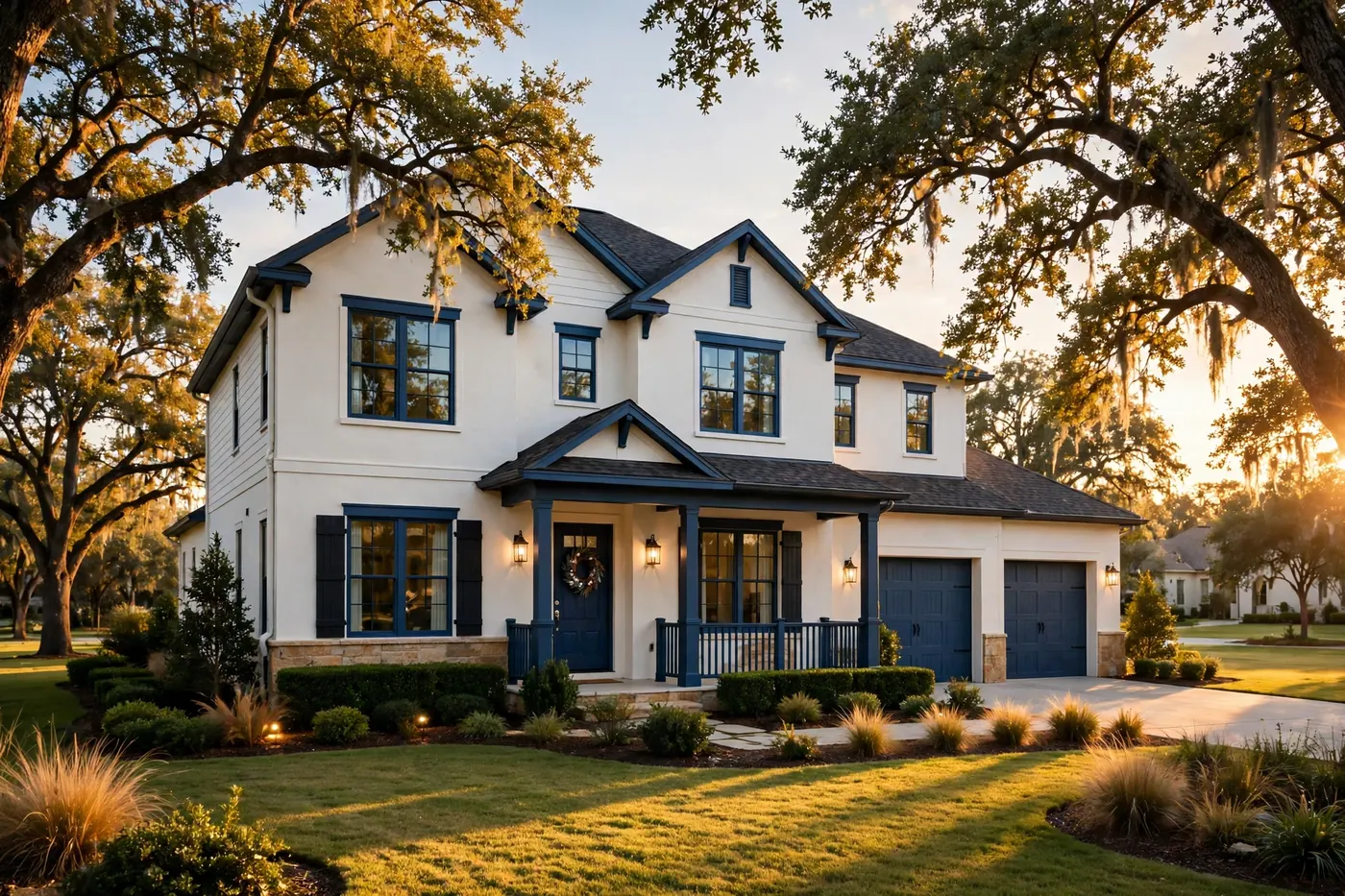
Dark colors absorb heat. A deep navy or charcoal wall in Grand Lakes can run much hotter than a light wall on the same street, and that heat works the paint and the caulk harder. Dark colors also tend to show fading sooner on south and west exposures. That does not mean you can't use them. It means you should use a quality acrylic paint, expect a little more maintenance and think about saving the darkest color for the front door or the shutters instead of the whole body of the house.
Lighter colors reflect heat and usually fade slower. In Cinco Ranch and Seven Meadows, your HOA palette may limit you anyway, so bring that palette to the consultation. We'll help you build a body, trim and door mix that fits the rules and still looks like your house, not a copy of the one next door.
You can buy the right paint and still lose the job on timing. If a wall is baking in direct sun, fresh paint can dry on the surface before it bonds, and you'll get lap marks and blisters. A good crew works the shade around the house, paints the west wall in the morning and watches the surface, not just the air temperature. Evening matters too. If paint goes on late and dew settles on it before it cures, the finish can turn dull and soft.
Rain windows matter in Fort Bend County because a dry morning can turn into a storm by 3. Your project manager should schedule around the forecast and tell you plainly if a day needs to shift. That's part of how we run exterior painting jobs, and it's built into our 6 step process. We start with a free consultation and a walk around your home, then you get a personalized written quote, then you approve it or adjust it with us. After that, your project manager calls to schedule, a 20 percent down payment is due by your start day to cover materials, and we finish with a walkthrough together where we check every wall before we call it done.
We're insured, estimates are free, and homeowners have given us a 5.0 rating across 13 Google reviews. We serve 27 areas, from Fulshear, Katy and Sugar Land to Richmond, Cypress, Rosenberg and Missouri City. I'd rather match the paint to your house in person than sell you a can name over the phone.
Is acrylic latex paint good for Texas heat? Yes. A quality 100 percent acrylic latex paint flexes as siding moves, holds color in strong sun and handles humidity better than cheaper blends. It's the starting point for most homes we paint.
What sheen should I pick for my siding? Satin for most siding, semi gloss for trim and doors. Satin sheds water and washes clean without looking shiny, and semi gloss gives trim a harder finish where it takes contact.
Can you paint when it's very hot? We can, if we work the shade, watch the wall temperature and stop before evening moisture settles. A sun baked wall at midday is a bad surface, so we sequence walls around the sun.
Will a dark color fade faster? Usually, yes, on south and west walls first. Dark colors absorb more heat and show chalking sooner. They can still work with a quality paint and a realistic maintenance plan.
If you're trying to pick paint for a house in Fort Bend County and you're not sure what your siding needs, start with a free look. Call 281-505-7525 and we'll walk the exterior with you, tell you plainly which surfaces are ready and which ones need repair first, and leave you a personalized quote with no pressure. You can also request a free quote online if that's easier.
Free consultation and an honest walk around your exterior. Call Jay at 281-505-7525 or request a quote online.