By Jay Gibson, Owner, Morson Painting & Renovations · November 28, 2026 · Fulshear, TX
If you're picking interior paint colors texas homes throw a curve most color guides don't mention, and it's the light. We get strong sun for a lot of the year, big windows in the newer builds out in Cross Creek Ranch and Jordan Ranch, and open floor plans where you can stand in the kitchen and see the entry, the living room and the breakfast nook all at once. A color doesn't sit in a little box here. It bounces off wood look tile, it picks up the red in a brick fireplace, it goes warm at noon and cool after a front blows in. Folks in Fulshear and Missouri City call us after they've already painted a room twice, and the story's almost always the same. The chip looked right at the store. The first coat didn't. A color consultation is just a slower, smarter way to pick, so you paint it once and you're done.
Start with what isn't changing
Paint is the easiest thing in the room to change, so it should be picked last, not first. Walk the room and list what's staying. Flooring is the big one. Honey oak and warm wood look tile throw yellow and orange up onto the walls all day. Gray washed floors do the opposite and they'll make a warm white look dingy. Then look at the fixed stuff you can't move. Granite with gold veining in a Sienna kitchen, travertine backsplashes, red brick around a fireplace in Fulbrook, dark stained cabinets you're keeping. Those surfaces already have a color story. Your wall color has to get along with them, because they're not adjusting to it.
That's where undertones bite people. A greige that looks calm on a chip can flash pink next to travertine, or turn green next to oak cabinets. You won't see that on a one inch square. You'll see it plain as day on a two foot patch painted right beside the floor and the counter. If you're repainting cabinets too, pick the cabinet color and the wall color together, on the same day, in the same light. Picking them a month apart is how a kitchen ends up with white cabinets that make the walls look yellow.
Read the room's light before you read the chip rack
South and west facing rooms get the hard sun. In a Fulshear living room with a wall of windows facing the backyard, colors wash out at midday and warm up late in the day. A pale gray that looks soft in the morning can go almost white by 2 PM, and a warm beige can turn orange by sunset. If you love a light color for a bright room, go one step deeper on the strip than you think you need. It'll read the way you wanted once the sun hits it.
North facing rooms never get direct sun, so they live in flat, cool light all day. That's where whites go blue and grays go cold and a little sad. Folks in Missouri City ask for a bright white bedroom that faces north, then wonder why it feels like an office. A warmer white or a color with a little cream in it fixes that without going yellow.
Rooms under trees or deep porches in older parts of Richmond and Pecan Grove get green bounce from the yard. It's real, and it'll push a neutral toward green whether you planned it or not. Test there for sure, and lean a touch warm to balance it.
Lamp light counts too. Most homes here run warm bulbs in the evening, and that's when you're actually sitting in the living room. A color you only checked at noon is a color you've only half checked. Look at your test patch at breakfast, at mid afternoon, and after dark with the lamps on. If you like it all three times, you've got a winner. If it falls apart at night, it doesn't matter how good it looked at noon.
The test routine that actually works
Pick two or three finalists, not ten. Ten chips on a wall just makes everybody tired and nobody decides. Get a sample pot of each, and paint a patch at least two feet square on two different walls, one that gets sun and one that doesn't. If you don't want paint on the wall yet, paint a big piece of foam board and move it around the room, tape it next to the trim, prop it by the floor, hold it by the cabinets. Check it for two full days if you can. Colors shift as they dry, too, so don't judge a patch while it's still wet. Wet paint lies. It dries darker and flatter than it looks going on.
Paint your trim color next to the wall color while you're at it. Stark bright white trim will make a soft wall color look dirty, and creamy trim will make a crisp wall color look yellow. They come as a pair in the finished room, so test them as a pair. Same goes for ceilings. Most of our ceilings here aren't true white once you put a fresh white next to them, and a ceiling that reads a little yellow will pull the whole room with it.
Open plans need a plan, not one color everywhere
The big open builds in Cross Creek Ranch, Elyson and Sienna are where homeowners get stuck most. You can see five surfaces from the front door, so every color has to get along with every other color in the sight line. That doesn't mean the whole downstairs has to be one color. It means the colors need a reason to be together. A setup we use a lot is one main color for the shared space, the same color family a step or two deeper for a dining room or study that sits off it, and the trim color carrying through all of it so the eye gets a steady thread. Bedrooms and bathrooms behind closed doors can go their own way. Nobody sees your primary bedroom and your kitchen in the same glance, so they don't have to match. They just have to make the people sleeping there feel good.
Watch the transitions, too. A strong color that stops mid wall at an open corner looks like a mistake even if the color itself is great. End bold colors where the architecture gives you a stopping point, a doorway, a column, a change in ceiling height. If the house doesn't give you a stopping point, that's the house telling you to keep that space in the main color and save the strong one for a room with doors.
Colors that hold up well in our light
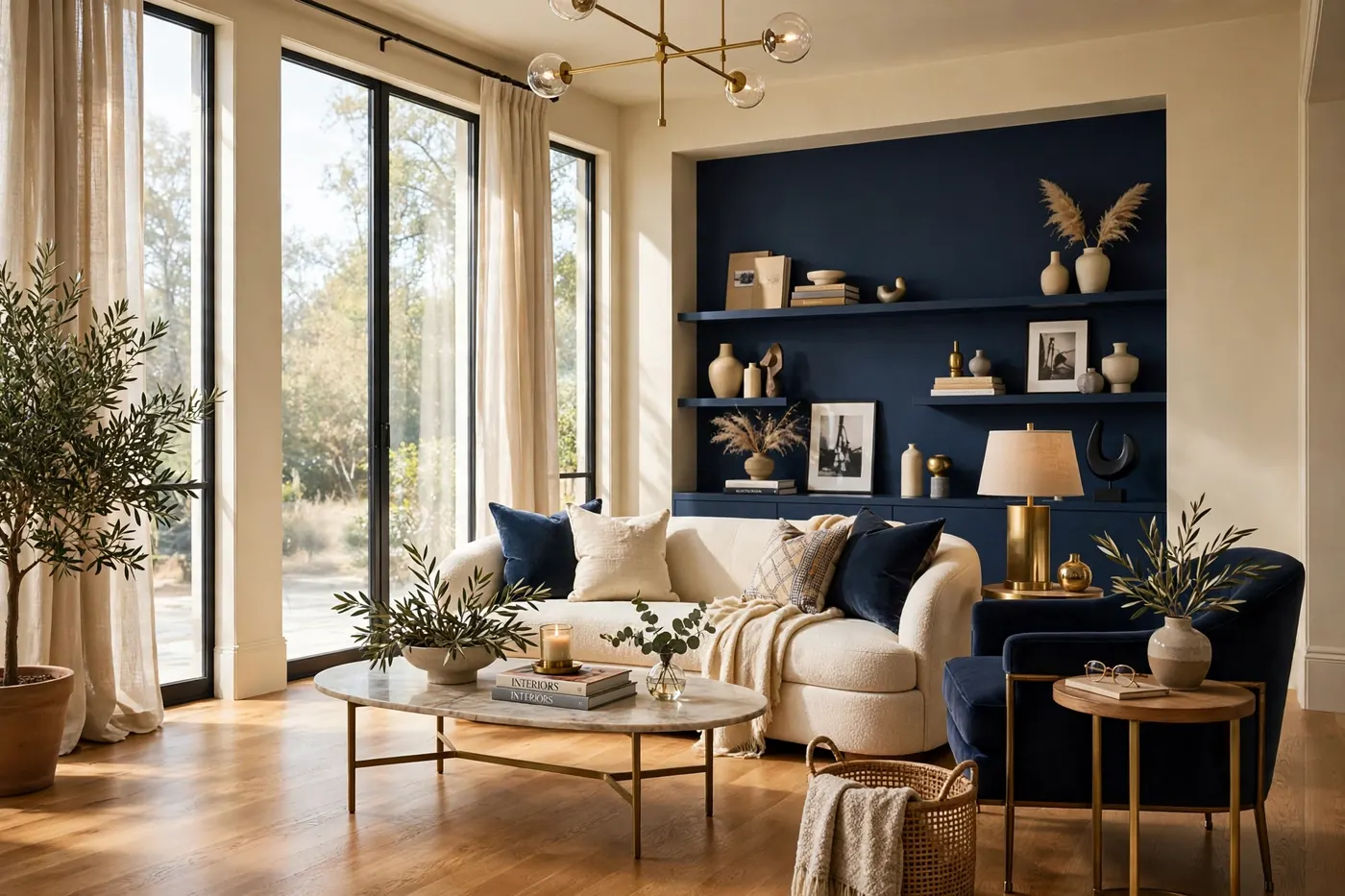
Warm whites and soft greiges do a lot of work here because they handle strong sun without going cold and they sit well next to the wood tones and stone in Fort Bend County homes. Sage and muted blue greens work in bedrooms and studies, especially on the north side of a house where a little color keeps the room from feeling flat. Deep navy and charcoal have their place, usually on cabinets, an island, a study or a front door inside the entry, not on four walls of a bright living room where they'll eat the light and show every sheetrock flaw. Speaking of flaws, sheen matters as much as color. Flat paint hides wall texture and patch marks but scuffs if you look at it hard. Eggshell and satin clean up better in halls, kitchens and kids rooms, and they'll show a little more of what's under them. That's why prep still runs the show, and it's laid out step by step on our interior painting page.
Questions we hear in Fulshear and Missouri City
Why did my gray turn blue? Because most grays carry a blue, green or violet undertone, and strong Texas daylight finds it and pulls it forward. In a bright room, pick a gray with a warm undertone and test it big. The undertone you barely see on the chip is the one you'll live with on the wall.
Can you help us pick, or do we have to have colors ready? You don't have to have them ready. Color help is part of how we start an interior job. We'll look at your floors, your fixed finishes and your light with you, narrow it to a few finalists, and get real samples on your walls before anybody commits to gallons.
How many colors should a house have? Fewer than most people fear and more than one. A main color, a trim color, and one or two room colors behind doors covers most homes we paint. More than that and the house starts to feel chopped up, especially in an open plan.
I've been painting for over 18 years, and I'll tell you plain, picking the color is the part homeowners lose the most sleep over and the part that costs the least to get right. It just takes samples on your wall, in your light, given a day or two to tell the truth. We're insured, our Google rating is 5.0 with 13 reviews, and estimates are free. If you're stuck between three whites that all look the same at the store, call 281-505-7525 and we'll walk the rooms with you, talk through what's staying and what the light's doing, and leave you a written quote with no pressure. If you book the job, there's a 20 percent down payment due by your start day, and we follow the same 6 step process we use across all 27 of our service areas, from the first walk through to the final check in the daylight. You can also ask for a free quote online, and there's more plain spoken help like this on the blog.
← More from the Morson blog · Get a free quote · Meet Jay